How Can AI Eliminate Redundant Work in Major Incident Management?


Ready to make incident response your competitive advantage?
See how Uptime Labs builds provable, scalable incident response capability across your organisation.
One question that pops up regularly in my conversations is: “How can we use AI to make major incident management more efficient without making things worse?”
AI has incredible potential to cut down on redundant tasks, free up resolvers for higher-level thinking, and speed up incident response. But here’s the catch: if you don’t adapt your processes and train your people properly, AI can actually introduce more problems than it solves.
To successfully implement AI in Major Incident Management, organisations need to focus on three critical areas.
Note: This is a rapidly evolving space, and my perspective will likely shift as I learn more and as the ecosystem continues to develop.
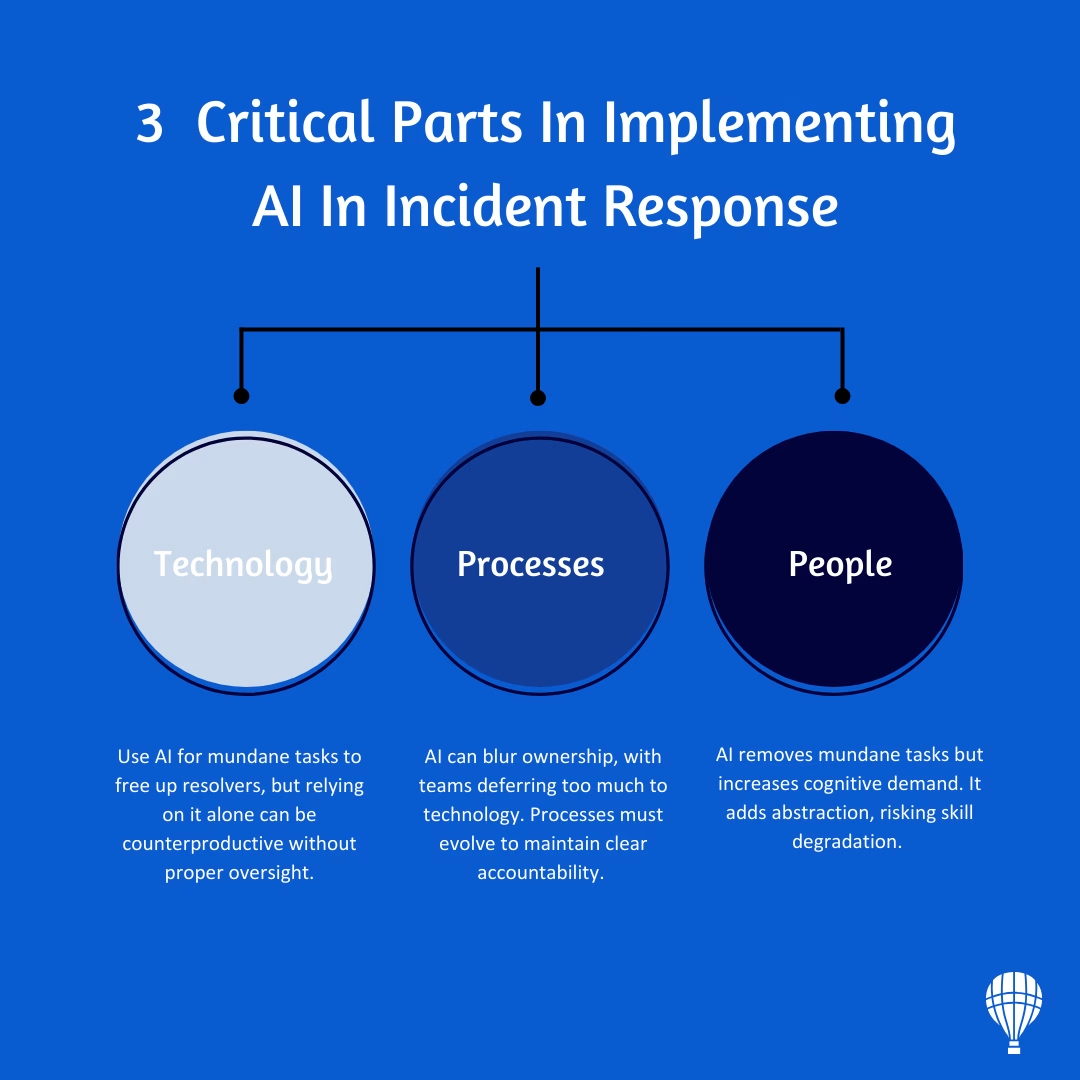
Technology (The Easy Part – Automate, But Don’t Abdicate)
AI can ( or shall I say - perhaps can handle as only time will tell) handle alert triage, status updates, and pattern recognition, freeing responders to focus on complex problem-solving. But, it works based on historical data, and if that data has gaps or biases, the AI will misinterpret incidents. We’ve seen teams blindly follow AI-generated recommendations, only to realise later that key context was missing.
AI alone won’t fix your incident response—it needs structured integration into workflows to be effective.
- Use AI to reduce noise, not replace human oversight
- Leverage AI for early detection, predictive insights, reducing toils and automating mundane tasks
- Ensure AI outputs stay explainable and auditable - It adds another layer of abstraction but It’s working should be transparent.
Process (The Harder Part – Evolve to Avoid Accountability Gaps)
Here’s where things get tricky. When AI starts handling parts of the incident workflow, roles and responsibilities shift—sometimes in ways teams don’t anticipate.
Common process challenges:
- Who’s actually responsible? If AI flags an issue but no one knows who owns it, teams waste time figuring out who should take action.
- Over-reliance on AI: If teams assume that AI is always right, they might stop challenging alerts or recommendations—even when something feels off.
- Mismatched workflows: Different teams adopt AI at different speeds, which can create friction when AI-driven workflows interact with manual ones.
- “When AI fails,” who’s responsible? AI is a technology, and like any system, it can fail—whether due to incorrect correlations, outdated models, or misclassified incidents. Teams need a clear plan for when AI gets it wrong.
- Bumpy handover of control: When AI hands over an incident to humans, how and when this happens matters. Poor handovers can result in missing critical context, loss of incident history, or unprepared responders struggling to take over effectively.
AI changes who does what during an incident, often blurring ownership and responsibility. Without adapting workflows, teams risk over-reliance on automation and missed handoffs.
Orgs need to make sure they:
- Redefine roles to clarify human vs. AI responsibilities
- Keep decision-making authority with trained responders
- Continuously audit and refine workflows as AI capabilities evolve
People (The Hardest Part – AI Changes the Skill Set, Not Just the Workload)
AI removes some mundane tasks, but it also raises cognitive demands on responders. Teams must be trained to interpret AI recommendations, think critically, and challenge assumptions when needed.
Why?
- AI introduces a new layer of abstraction—teams need to understand how and why the AI is making recommendations.
- Skills degradation happens if teams rely too much on AI and stop practicing troubleshooting.
- AI produces a flood of insights—sometimes, too much information at once can be overwhelming rather than helpful.
So, How Do You Make AI Work for Major Incident Management?
AI isn’t a plug-and-play solution—it requires thoughtful integration.
Here’s how I (right now) believe it should work:
- Reinforce incident leadership skills so teams don’t just “follow the AI”
- Use AI as a support system, not a decision-maker. Keep humans in the loop.
- Redefine workflows to clarify who owns what when AI is involved.
- Train teams on AI literacy—help them understand its strengths, weaknesses, and when to challenge it.
Did I miss anything? Would love to hear your thoughts in the comments!
Hamed Silatani