Ready to make incident response your competitive advantage?
See how Uptime Labs builds provable, scalable incident response capability across your organisation.
At Uptime Labs, we frequently ask: “What are you actually noticing when you’re noticing great incident response?”
This is such a powerful question as it doesn’t pressurise the respondent into defining great incident response: it simply asks them to talk about what they’ve noticed during specific occasions when they’ve felt things going well. We all get that kind of a sense of when an incident is going well…or not so well, but it’s not so easy to translate that sense into words.
One of the most frequent answers we hear is, ‘Good Communication’. Everyone agrees on the value of good (or excellent, even!) communication, and most people have a keen sense of when they’re witnessing it. Ask people to describe what it is they’re witnessing, however, and things tend to become rather more tenuous.
It can be tricky to describe what good communication actually is without circling back to the words ‘good' and 'communication’. You might hear descriptions such as: clearer updates, fewer words, less jargon, a clear direction. None of these is wrong, but neither are they helpful in distilling its essence.
Worse, you may hear that good communication requires confidence, charisma or leadership skills. While these attributes may sometimes correlate with good communication, they’re not causative or necessary.
Luckily, it turns out that the recipe for good communication is simple. The first thing to consider is that communication is a process that requires more than one person. It’s a joint activity in building shared understanding in which all parties are active participants.
If a tree communicates in the woods and nobody’s there to hear, did it even communicate?
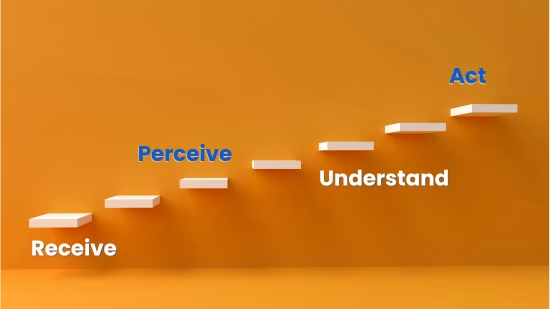
Secondly, Herbert Clark (1996) described a sequence of conditions (The ‘Joint Action Ladder’) that must be met before communication can be said to have ‘happened’.
- A message from one person (the sender) needs to have been received by at least one other person (the recipient(s)). This is obvious but not always guaranteed. Networks may be down, the room may be noisy, Slack might be offline, etc…
- The message needs to be perceived by the recipient. Again, this is obvious but not guaranteed. A single Slack message within a major incident bridge avalanche can easily get missed amongst the noise, despite being received.
- The message needs to be understood by the recipient in the way that the sender intended. Difficult to guarantee (I’ll elaborate more on this in a future post).
- The recipient must act on the message, indicating that they have received, perceived and understood the message and ideally stating what they will do next.
If a communication between two or more parties successfully scales this ladder, then it will have been achieved successfully. It’s so simple, but it’s amazing how frequently communication attempts fall off the ladder.
At Uptime Labs, we see hundreds of examples of intra-incident communication. Over the recent Incident Fest, we were lucky enough to witness world-class incident responders working together, demonstrating this ladder in action.
Sarah (sender): I need a clear of what business impact is, uh, Alex, can you try and get a business impact statement and handle like an internal and external comms in that business comms channel?
Though these messages are presented here out of context, note that this communication is a joint activity between Sarah and Alex.
Firstly, Sarah uses Alex’s name, so Alex is 100% clear that the message is for him, rather than the other people on the bridge. Secondly, Alex acknowledges Sarah, indicating that he has at least received and perceived her message. Further clarification then takes place, indicating that the message has been understood and is being acted upon.
Here’s another example:-
Sarah: But Alex, what's your thought?
Note here that the ladder isn’t a linear sequence, the steps of which all need to be taken independently and discretely. An acknowledgement of understanding immediately implies that the message has been received and perceived. Also, notice that both Sarah and Alex are involved with receiving, perceiving, understanding and acting - underpinning the fact that communication is bi-directional.
Perhaps you can recall or imagine examples of attempted communication where some of these steps were omitted entirely, perhaps contributing to undesired consequences? How many times have you ‘communicated’ a message but received nothing in return? Hopefully, this short post will help folks understand the difference between effective communication and mere messaging.
Notes / References
I first read about Clark’s Joint Action Ladder in the paper “Common Ground and Coordination in Joint Activity” (2004) by Klein, Feltovich and Woods.
Clark’s Joint Action Ladder was first described in Herbert H. Clark Using language Cambridge: Cambridge University Press 1996.

Stuart Rimell